
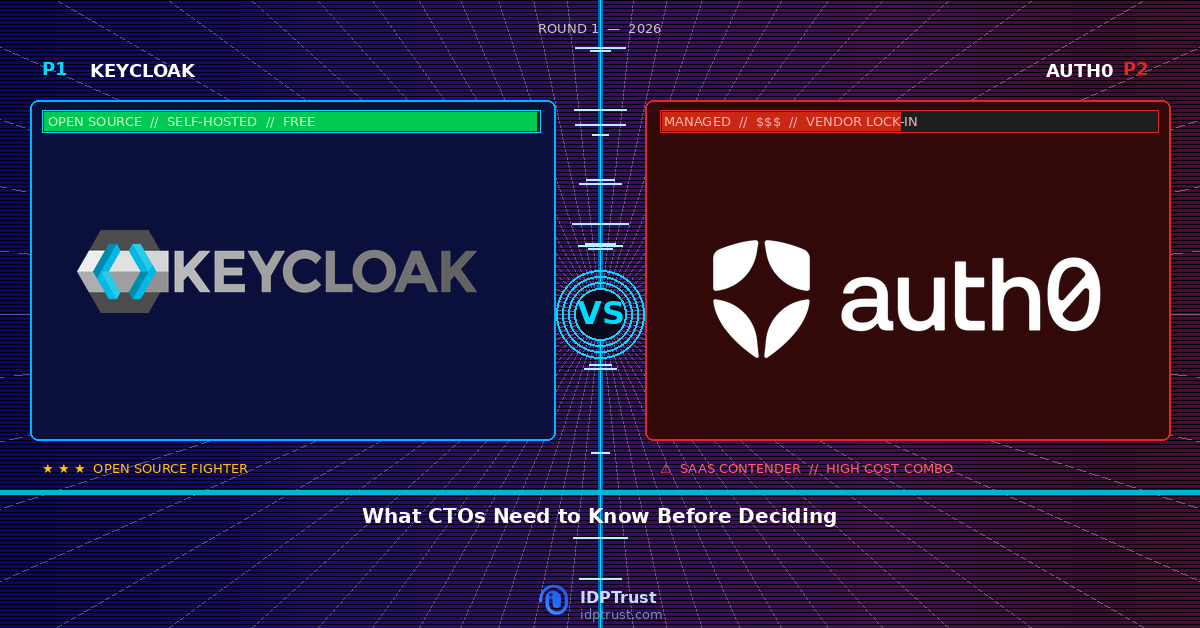
Keycloak vs Auth0 in 2026: What CTOs Need to Know Before Deciding
· IAM · IDPTrust
We work with Keycloak every day. That gives us perspective — but it also means we have to be honest: Auth0 is an excellent product, and there are cases where it's the right choice.
This post is not a case for Keycloak. It's the comparison we'd walk a CTO through if they had to make the decision in the next 30 days.
The Context That Changed Everything
In 2021, Okta acquired Auth0 for $6.5 billion. What followed was predictable: plan restructuring, tier elimination, and price increases that caught many companies off guard — companies that had built their identity architecture on Auth0.
This isn't a criticism — it's the logic of any acquisition at that scale. But for a CTO evaluating their identity stack today, it means the Auth0 economics of 2019 are not the economics of 2026.
That's what's pushing many companies to reopen this conversation.
The Real Cost Model
Auth0 charges by MAU (Monthly Active Users) — users who authenticate at least once per month. That sounds reasonable until you calculate what happens as you grow.
| Active users | Auth0 (approximate) | Keycloak |
|---|---|---|
| 30,000 MAU | $2,100/month | Infrastructure cost |
| 200,000 MAU | Negotiated pricing | Infrastructure cost |
Auth0 pricing varies by plan and changes frequently. Verify on their website before comparing.
With Keycloak, the cost is infrastructure (servers, database, monitoring) plus the team that operates it — internal or external. Beyond a certain volume, the difference is significant.
Control vs. Managed Service
This is the real tension, and it has no universal answer.
Auth0 gives you:
- Very fast time to production — hours, not weeks
- Managed infrastructure, no on-call rotations for your IDP going down
- Excellent documentation and a developer experience few tools can match
- Automatic security updates
Keycloak gives you:
- Full control over authentication flows, token structure, and access policies
- Real extensibility — you can modify almost any behavior through SPIs and extensions
- No MAU limits or surprise invoices
- Deployment flexibility — on-premises, your cloud, or any regulated environment
The question is not which is better in the abstract. It's whether your organization has — or can get — the operational capacity to take advantage of that control.
Data Sovereignty: The Factor Most Companies Overlook
With Auth0, your users' identity data — emails, metadata, session history — lives on Okta's servers. For many companies, this isn't a problem. For others, it is.
Situations where it matters:
- GDPR in the EU: you need to know exactly where data lives and be able to demonstrate international transfer compliance
- Regulated sectors (banking, healthcare, government): data residency requirements may directly rule out third-party SaaS solutions
- Enterprise customers: some contracts include clauses restricting where authentication data is processed
With Keycloak, data lives where you decide. Full stop.
The Risk Nobody Measures: Vendor Lock-in
Auth0 is built on open standards — OIDC, OAuth 2.0, SAML. In theory, migrating should be possible.
In practice, the lock-in comes from elsewhere:
- Business logic encoded in Actions (Auth0's proprietary scripting system)
- Hooks and login flows built with their specific UI
- User metadata in their data structure
- Integrations with their marketplace
Migration isn't impossible, but it carries a real cost in engineering time. And that cost grows every year you keep building on the platform.
With Keycloak, the standard is at the center of everything. If you ever want to switch, the protocol — OIDC, SAML — is yours and portable.
When Auth0 Makes Sense
Let's be clear: there are scenarios where Auth0 is the right choice.
- Early-stage startup that needs authentication in production this week, with no infrastructure team
- MVP or proof of concept where speed is everything and cost isn't the constraint
- B2C SaaS product with a small, stable user base
- Team without infrastructure operations experience and no budget for a specialized partner
In these cases, Auth0's simplicity and speed outweigh the cost and dependency. There's no point running Keycloak if you don't have the conditions to run it well.
When Keycloak Wins
- Regulated sector — banking, healthcare, insurance, government — where data sovereignty is non-negotiable
- Complex architecture requiring custom authentication flows, identity federation, or legacy system integration
- Multi-tenant strategy with per-customer isolation requirements
- Technical teams with infrastructure operations capacity, or access to a specialized partner to handle it for them
In these scenarios, the control Keycloak provides doesn't just justify the operational cost — it surpasses it.
The Decision
If you're evaluating this now, the most useful question is not "which one is better?" but "what will cost us more in three years: operating Keycloak or depending on Auth0?"
That answer depends on your user volume, your sector, your team, and your tolerance for dependency on an external vendor.
If you want to work through the numbers with your specific context, let's talk.
At IDPTrust we are Keycloak specialists. If you're in the middle of this decision, we can help you evaluate your options without bias.